
Comet From Edge of Solar System to Be Visible From India — And It Will Never Return
Its long journey, spanning millions of years from the Oort Cloud, reached a critical point on January 20, 2026, when it made perihelion, its closest...
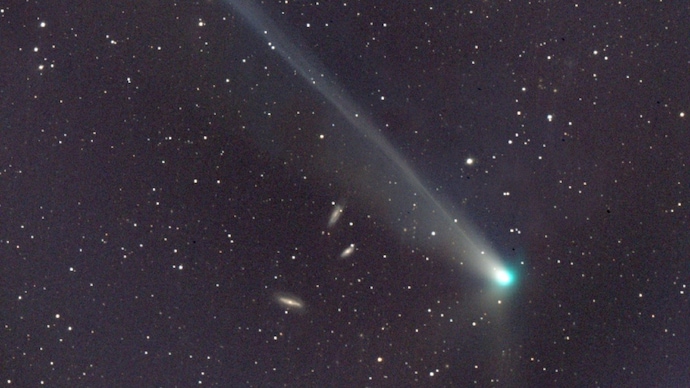
Its long journey, spanning millions of years from the Oort Cloud, reached a critical point on January 20, 2026, when it made perihelion, its closest approach to the Sun.
Top Summary
What happened: A hyperbolic, outbound comet C/2024 E1 (Wierzchos) is passing near Earth and will be visible from India this month.
Why it matters now: This is a one-time celestial event, as the comet’s hyperbolic orbit ensures it will never return to the Solar System.
What changes for people: Skywatchers in India can observe it with binoculars or small telescopes under dark skies; visibility peaks shortly after sunset.
Who is affected: Astronomers, observatories, astrophotographers, and sky-watching enthusiasts worldwide.
A cosmic visitor millions of years in the making, Comet C/2024 E1 (Wierzchos) has entered the inner Solar System for the first — and last — time. Its unusual hyperbolic trajectory ensures that once it slingshots around the Sun, it will be ejected into deep interstellar space.
A discovery from the Solar System’s doorstep
The comet was discovered in March 2024 by Polish astronomer
Kacper Wierzchos during a routine scan for near-Earth objects under the Mt. Lemmon Survey.
Key details:
Initially detected as a 20th-magnitude faint object in the constellation Draco
Originates from the Oort Cloud, the farthest icy shell of our Solar System
Its path is hyperbolic, meaning it is not gravitationally bound to return
This makes the comet scientifically invaluable — a pristine remnant from the Solar System’s birth.
Why the comet will never return
Unlike periodic comets like Halley, C/2024 E1 follows a hyperbolic orbit:
Its velocity is greater than escape velocity near the Sun
Solar gravity cannot pull it back
It will exit the Solar System permanently after its 2026 passage
Astronomers call such comets “one-and-done visitors.”
Visibility from India
Skywatchers in India can spot the comet:
In early evenings, shortly after sunset
Low in the north-western sky
Best viewed from dark, low-pollution rural areas
Recommended gear: binoculars or a small telescope
Urban light pollution will make naked-eye viewing difficult.
What makes this comet special
C/2024 E1 is scientifically important because:
It carries ancient ices and dust untouched since the Solar System’s formation
It offers clues about early planetary building blocks
Its hyperbolic path may hint at past gravitational interactions — possibly with passing stars or giant planets
The last time Earth saw such a comet may have been centuries ago, and the next could be generations away.