
Comet 3I/ATLAS: New Images From Hubble, ESA’s Juice & Amateur Astronomers Spark Fresh Debate
Comet 3I/ATLAS, the third known interstellar object to pass through our solar system, has once again captured global attention. Recently observed by NASA’s Hubble Space...
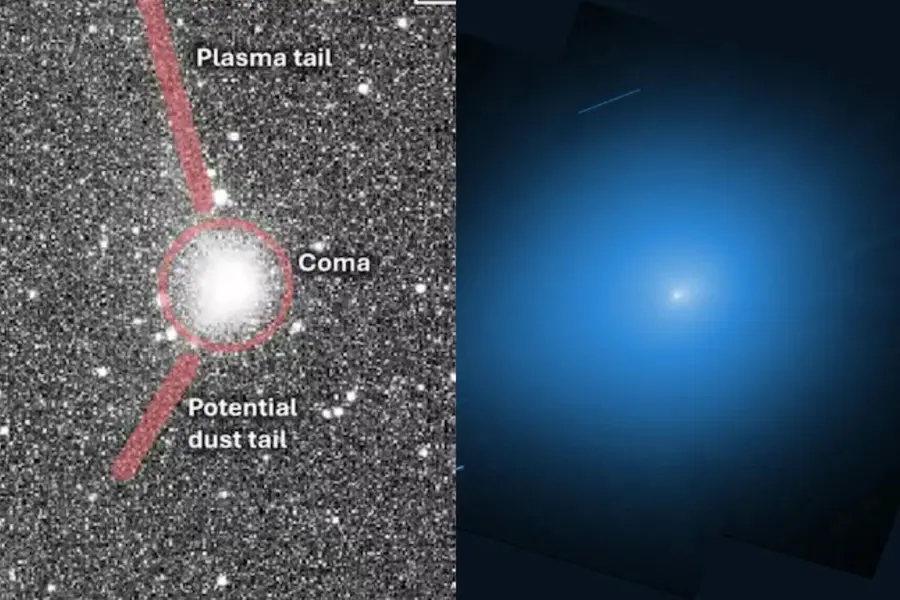
Comet 3I/ATLAS, the third known interstellar object to pass through our solar system, has once again captured global attention. Recently observed by NASA’s Hubble Space Telescope, ESA’s JUICE spacecraft, and even amateur astronomers, the comet has become a scientific celebrity — and a subject of heated debate.
While NASA has consistently labeled 3I/ATLAS a comet, Harvard astrophysicist Avi Loeb has suggested that the object shows multiple “anomalies” and might even be artificial — potentially an alien technological relic.
3I/ATLAS will make its closest approach to Earth on December 19, 2025, but ahead of that, new images from different space missions are offering fascinating insights.
🔭 Image From NASA’s Hubble Space Telescope
“Hubble Space Telescope reobserved interstellar comet 3I/ATLAS on November 30.”
Photo Credit: NASA/Hubble
Hubble was among the first telescopes to observe 3I/ATLAS after its discovery in July, capturing a teardrop-shaped dust cocoon surrounding the nucleus.
Its latest observation on November 30, 2025, taken with the Wide Field Camera 3, shows:
-
The comet 286 million km from Earth
-
Background stars stretched into lines due to the comet's rapid movement
-
A bright central nucleus
-
A large coma of glowing gas and dust
-
A clearly visible tail and anti-tail
Avi Loeb noted in a Medium blog post:
-
The glow radius is ~40,000 km
-
The anti-tail extends ~60,000 km
NASA has not yet released the full data set from this latest Hubble observation. Once released, it will help determine the gas composition surrounding the comet.
🛰️ Image From ESA’s JUICE Mission
“At the centre of the image is a bright white blob with a faint white line stretching upward.”
Photo Credit: ESA/JUICE/NavCam
On December 4, ESA shared an image captured by the Jupiter Icy Moons Explorer (JUICE) spacecraft’s NavCam.
Taken on November 2, 2025, just two days before JUICE’s closest approach, the image reveals:
-
A bright core surrounded by a luminous coma
-
Two possible tails:
-
A plasma tail (electrically charged gas) stretching upward
-
A fainter dust tail extending to the lower left
-
ESA noted that data transmission is currently slow because the spacecraft is using its high-gain antenna as a heat shield, relying instead on its medium-gain antenna, which sends data at a much lower rate.
The full scientific data set will be released in February 2026, potentially offering groundbreaking insights into the comet’s composition and behaviour.
🔭 Image From Amateur Astronomers
Image taken by Gerald Rhemann & Michael Jäger
Photo Credit: Facebook/Gerald Rhemann & Michael Jäger
On December 2, 2025, renowned amateur astronomers Gerald Rhemann and Michael Jäger captured a stunning long-exposure image of 3I/ATLAS using a 12-inch telescope at Farm Tivoli, Namibia.
Their exposures lasted: 20 min + 6 min + 6 min + 6 min
Avi Loeb explained:
-
The field of view (75 × 110 arcminutes) corresponds to
6.1 × 9 million km
at the comet’s distance of 280 million km from Earth.
These amateur images are crucial because they capture the comet’s large-scale structure — its coma, tail, and outgassing patterns — in remarkable detail.
🌌 Why 3I/ATLAS Is Generating Global Buzz
-
It is only the third interstellar object ever detected after ’Oumuamua and 2I/Borisov.
-
Its behaviour is unusual, leading to speculation and scientific debate.
-
It is approaching Earth on December 19, 2025, offering a rare observational opportunity.
-
Multiple space agencies — NASA, ESA, and others — are conducting simultaneous observations.
With more data expected from NASA’s Hubble team and ESA’s JUICE mission in the coming months, the world may soon get clearer answers about this mysterious visitor from beyond our solar system.