
Black Hole Collision Reveals Spacetime Whirlpool Signature, New Wave Detected
Scientists decode a hidden "direct wave" from a black hole merger, revealing how spinning black holes drag spacetime.
Top Summary
- What happened: Researchers successfully decoded a previously hidden "direct wave" from GW250114, the loudest black hole merger ever recorded. This wave provides evidence of how rotating black holes drag spacetime around them.
- Why it matters: This detection opens a crucial new source of information about black holes and their event horizons, providing unprecedented opportunities to test Einstein's theory of general relativity.
- What changes: It deepens our fundamental understanding of extreme gravity and spacetime, pushing the boundaries of current physics theories without immediate direct impact on daily life.
- Who is affected: Astrophysicists, theoretical physicists, and scientists studying gravitational waves, general relativity, and quantum mechanics will use this new observational tool.
Unveiling a Cosmic Secret
Black holes, while mysterious, reveal their presence through cataclysmic events. When two black holes merge, they create massive gravitational waves, ripples in the fabric of space and time.
These waves, though minuscule by the time they reach Earth, are detectable by advanced observatories like the Laser Interferometer Gravitational Wave Observatory (LIGO) in the United States.
Last year, scientists recorded GW250114, the most powerful black hole merger event to date. This "loudest" collision offered an unprecedented look at a newly formed black hole.
Now, researchers have successfully isolated a hidden part of this signal, termed the "direct wave." This groundbreaking discovery, published today in Nature, reveals how spinning black holes dramatically influence their surroundings.
The Spacetime Whirlpool Effect
The detected "direct wave" carries crucial information from the region just outside the black hole's event horizon. This boundary is where gravity is so intense that nothing, not even light, can escape.
Einstein's theory of general relativity predicts peculiar phenomena in this extreme region. A spinning black hole doesn't merely exist in space; it actively produces "frame dragging," whirling spacetime around with it.
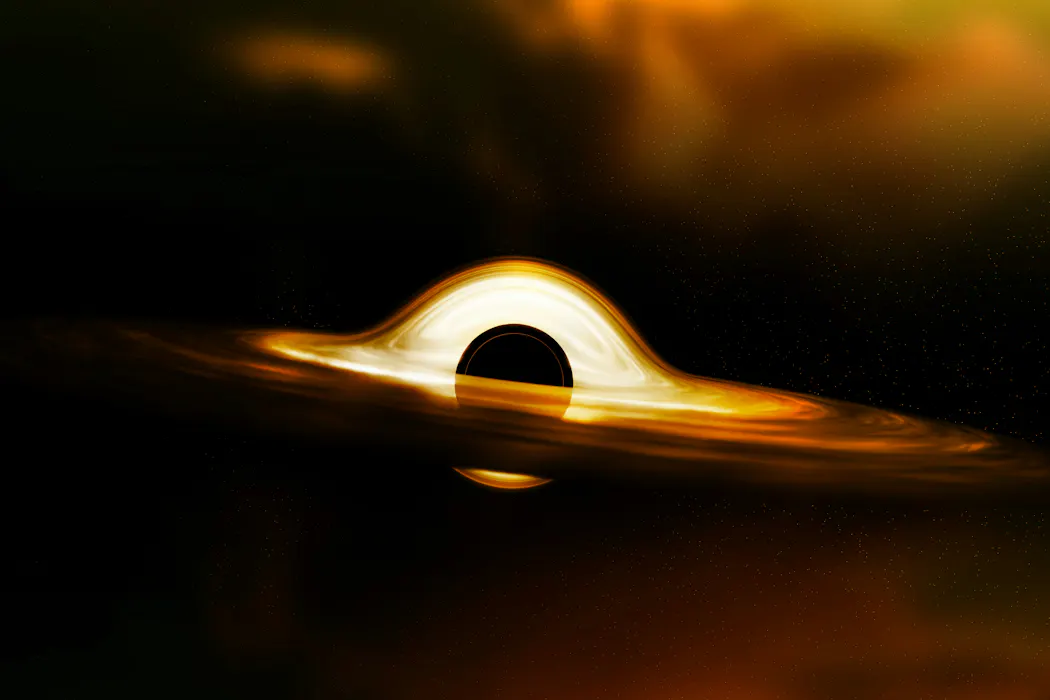
This effect is akin to a cosmic whirlpool. Anything that drifts too close to a rotating black hole is forced to turn with the fabric of spacetime itself.
Unlike a water current, it is spacetime that is being dragged around. The direct wave allows scientists to study the black hole's rotation speed and the strength of gravity at its event horizon.
A New Window to the Horizon
The existence of this direct wave had been predicted theoretically but remained undetected until now. Its clear signature was previously hidden among other powerful waves generated by the merging black holes.
The exceptional strength of GW250114 provided a perfect opportunity for this hunt. Researchers employed innovative techniques to separate the subtle direct-wave component from the louder gravitational wave signals.
Detecting the direct wave opens an entirely new source of information. It offers the closest direct observation of a black hole's event horizon, a region previously only accessible in theory.
Since light cannot escape from this proximity, gravitational waves, particularly these direct waves, are the only viable method to study these extreme boundaries.
Probing Beyond Current Theories
This groundbreaking research also paves the way for rigorous future tests of Einstein's theory of general relativity. The theory predicts specific relationships between direct waves, horizon rotation, and surface gravity.
Black holes represent a frontier where humanity's two major physics theories, general relativity and quantum mechanics, potentially conflict.
General relativity governs large-scale gravity and spacetime, while quantum mechanics describes matter at the smallest scales. Both are incredibly successful, underpinning technologies like GPS and emerging quantum computers.
However, they fundamentally disagree when applied to extreme conditions, such as those near an event horizon. By studying black holes with these new gravitational wave insights, scientists hope to uncover clues toward a unified theory of physics.
What to Watch Next
Scientists will now use this direct wave detection to further scrutinize Einstein's general relativity, looking for any inconsistencies. Future observations of black hole mergers will aim to refine our understanding of these extreme cosmic objects. This work could ultimately reveal "cracks" in current theories, guiding physicists toward a deeper, more complete understanding of the universe.