
Black Carbon's Climate Impact: Study Unveils Sources & Effects
Study reveals black carbon sources, climate effects, and model inaccuracies.
Top Summary
- What happened: A comprehensive review synthesized observations of black carbon (BC) concentrations, sources, optical properties, and climate effects.
- Why it matters: BC is a short-lived climate pollutant, and understanding its properties is crucial for accurate climate modeling and mitigation strategies.
- What changes for people: Clean air policies and technological advancements are showing progress in reducing BC loadings in some regions.
- Who is affected: Populations in regions with high BC concentrations like sub-Saharan Africa and South Asia, as well as global climate patterns.
Black Carbon's Regional Sources
Black carbon (BC) aerosols, significant yet uncertain climate influencers, are under renewed scrutiny.
Isotopic fingerprinting reveals that biomass burning contributes significantly to BC sources in different regions: 93 ± 3% in sub-Saharan Africa, 56 ± 7% in South Asia, and 28 ± 5% in East Asia.
Declining BC Loadings
Atmospheric BC loadings have seen declines in South America, East Asia, Europe, and North America.
These declines are attributed to clean air policies and advances in technology.
However, loadings have stabilized in Africa and South Asia.
Optical Properties and Climate Effects
The optical properties of BC directly influence its climate effects.
The global-mean mass absorption coefficient (MAC 550) of atmospheric BC is 12.3 ± 5.8 m2 g−1, with the highest values in Africa, Europe, and South Asia.
Ageing during long-range transport enhances MAC 550 by 1.6 ± 0.4.
Model Inaccuracies and Discrepancies
Model simulations show significant discrepancies when compared to observations.
In major emission regions, the aerosol absorption optical depth is lower in model simulations than in observations by a factor of 2.
The direct aerosol radiative forcing ratio is lower by a factor of 1.5.
“Relative to long-term observations, model simulations estimate higher BC deposition fluxes but lower concentrations and sunlight absorption.”
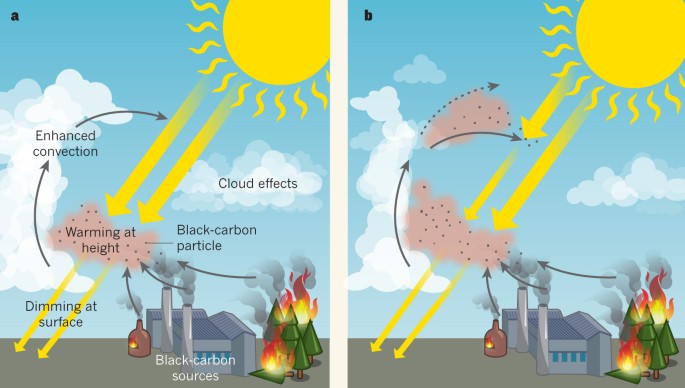
These inaccuracies can affect model representations of humidity, clouds, precipitation, and climate forcing.
Call for Future Research
Future research should focus on comparing emission inventory and model estimates with observations.
This will help enhance model accuracy and guide mitigation efforts.
What to Watch Next
Future studies will likely focus on refining emission inventories and model estimates to better align with observational data. Improving the accuracy of climate models is essential for predicting future climate scenarios and guiding effective mitigation strategies for black carbon and other climate pollutants.