
Astronomers find white dwarf star generating a colorful shockwave in space
• What happened: Scientists recorded a white dwarf creating a rainbow-like shockwave as it travels through interstellar gas.• Why it matters now: The finding reveals...
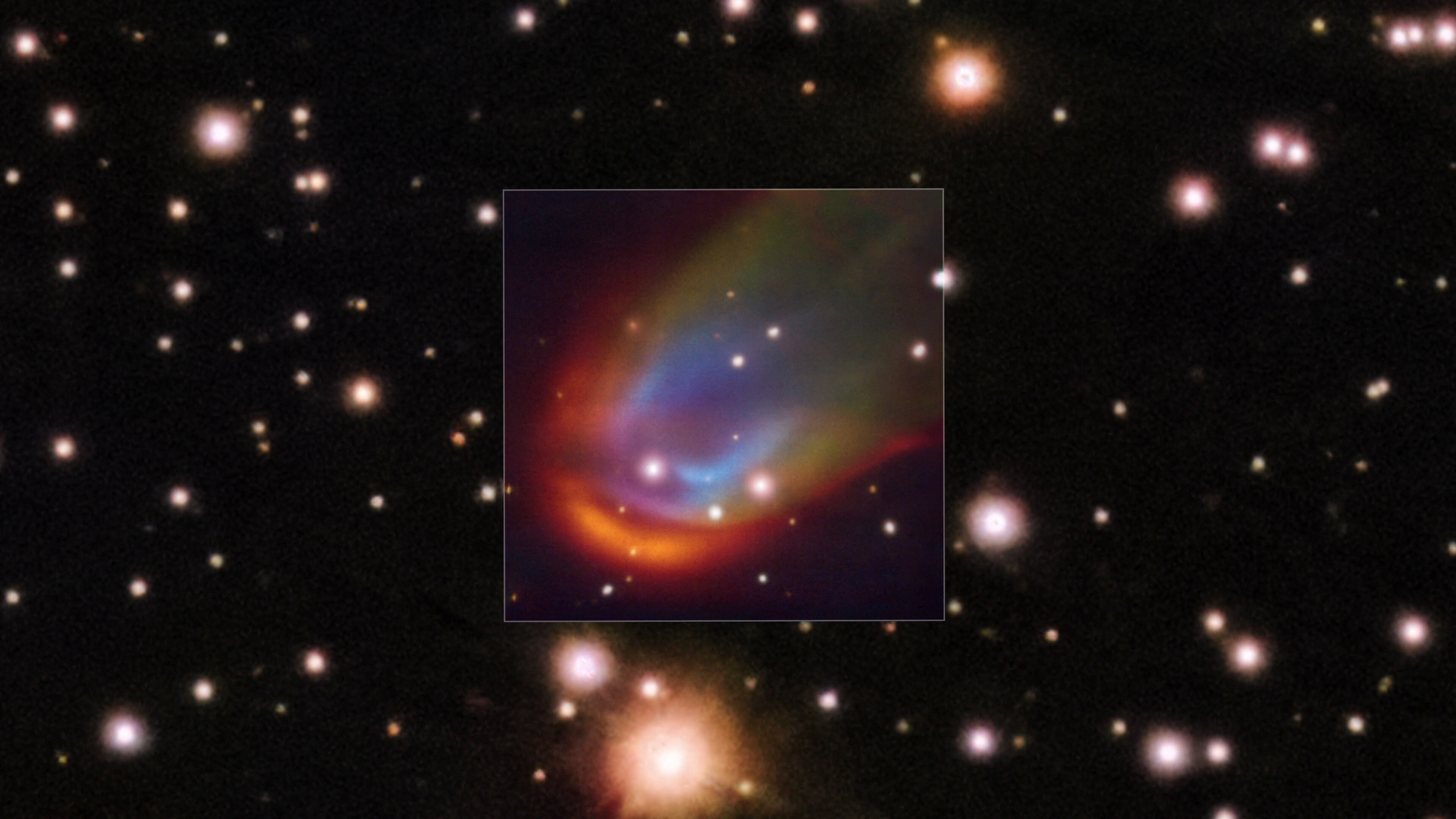
• What happened: Scientists recorded a white dwarf creating a rainbow-like shockwave as it travels through interstellar gas.
• Why it matters now: The finding reveals a mysterious long-term gas outflow that current astrophysics cannot explain.
• What changes for people: The discovery deepens understanding of stellar evolution and could reshape models of compact celestial objects.
• Who is affected: The research community working on cosmic magnetic fields, white dwarfs, and binary star systems.
Astronomers have confirmed the existence of a highly magnetized white dwarf star producing a colorful bow-shaped shockwave as it moves through space. The rare phenomenon was captured using the Very Large Telescope in Chile and published in Nature Astronomy, sparking new questions about how certain compact stars behave.
According to researchers from Durham University in England, the white dwarf is actively pulling gas from a red dwarf companion star, yet instead of collecting that material in a typical gas disk, it appears to eject part of it back into space. That expelled material forms a shockwave that glows in red, green, and blue, indicating hydrogen, nitrogen, and oxygen in the interstellar medium.
A rare stellar puzzle
White dwarfs are the compact remnants left behind when stars up to eight times the Sun’s mass run out of fuel and collapse. They are among the densest objects in the Universe after neutron stars and black holes.
What makes this case unusual is not the white dwarf itself, but the shockwave without a surrounding gas disk, which challenges existing models. Researchers stated that every known mechanism for ejecting gas in such systems fails to fully explain what they observed.
The system sits about 730 light-years from Earth in the constellation Auriga, a relatively close distance in galactic terms. The two stars circle each other roughly every 80 minutes, separated by about the same distance as the Earth and Moon.
Why experts are intrigued
Scientists note that the shock structure has been expanding for at least 1,000 years, implying a continuous and stable outflow rather than a short burst event. This longevity makes it even harder to explain.
Astrophysicists say the finding could reshape how they model magnetic fields, gas accretion, and mass transfer inside binary star systems.
One of the study’s co-lead authors said the team is “still puzzled” by the phenomenon, calling it a rare opportunity to study magnetic interactions between compact stars and the space around them.
What it means for astronomy
Such discoveries help astronomers refine models of how stellar remnants evolve, how binary systems exchange mass, and how magnetic fields shape cosmic environments. With the Sun projected to become a white dwarf billions of years from now, these insights provide a preview of our own star’s distant future state.