
Ancient Chinese Texts Help Scientists Recalculate Earth’s Rotation Using the Oldest Known Solar Eclipse
Researchers say the 2,700-year-old record may contain the earliest written description of the Sun’s corona A multinational team of astronomers and historians has re-examined one...
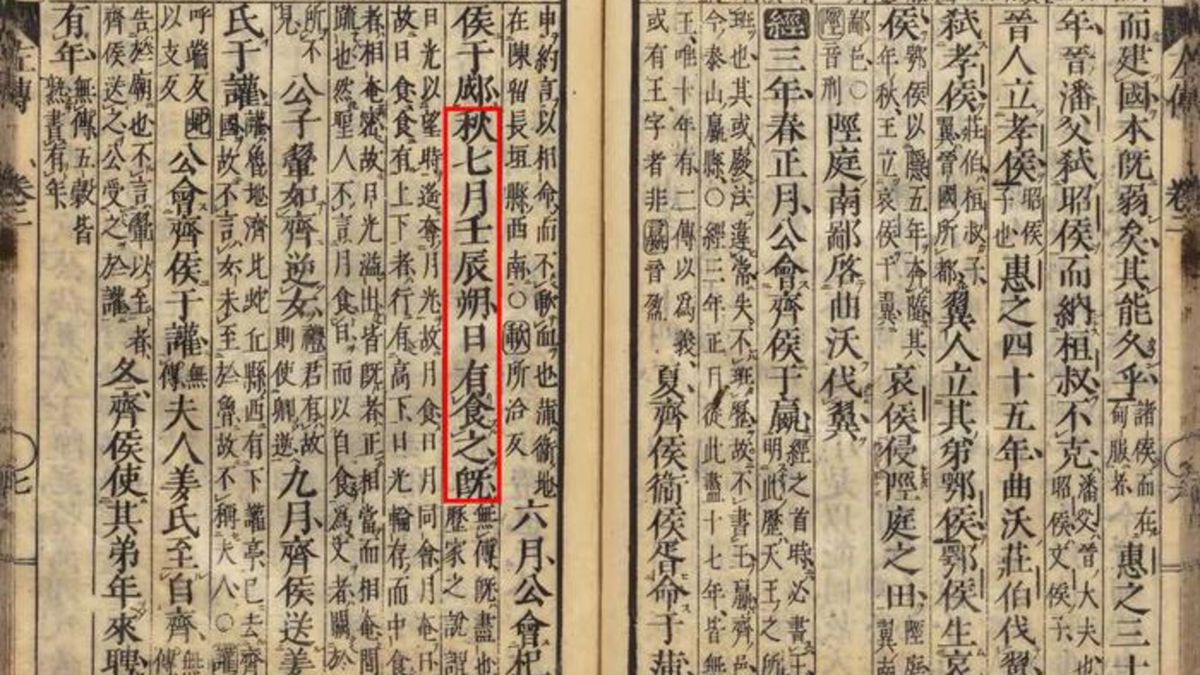
Researchers say the 2,700-year-old record may contain the earliest written description of the Sun’s corona
A multinational team of astronomers and historians has re-examined one of the oldest documented solar eclipses, uncovering new clues about how Earth’s rotation has shifted over millennia. Their findings, published on December 2 in Astrophysical Journal Letters, show that a celestial event long recorded in ancient Chinese literature occurred under conditions that modern science can now model with striking precision.
Revisiting a 709 BCE Eclipse Hidden in Classical Texts
The eclipse in question is dated to July 17, 709 BCE in the Spring and Autumn Annals, a chronicle associated with the Lu Duchy during China’s Zhou dynasty. Although the text itself was compiled several centuries after the event, it is one of the earliest surviving references to a solar eclipse anywhere in the world.
According to lead author Hisashi Hayakawa of Nagoya University, the record’s importance lies not only in its age but also in a later annotation preserved in the Book of Han. Written some seven centuries after the eclipse, the note describes the Sun as appearing “completely yellow above and below.” Researchers believe this is likely a poetic reference to the solar corona, the halo of light visible around the Moon during a total solar eclipse—possibly the earliest such description in human history.
Correcting the Map of an Ancient Capital
To test the validity of the Chinese account, the research team reconstructed Earth’s rotational behavior as it would have been in 709 BCE. Initial models showed that the eclipse path did not pass over Qufu, historically recognized as the capital of the Lu Duchy. This discrepancy had puzzled scholars for decades.
When researchers turned to updated archaeological and geographical surveys, they found that coordinates used in previous studies placed ancient Qufu several kilometers away from its actual historical location. Adjusting the site by roughly eight kilometers brought the eclipse into proper alignment.
Co-author Mitsuru Soma of Japan’s National Astronomical Observatory said the correction resolves longstanding inconsistencies in earlier eclipse calculations. By refining the ancient capital’s coordinates, scientists were able to produce a more accurate model of Earth’s rotation and reconstruct what observers in the Lu court would have seen that day.
Why These Findings Matter
Ancient astronomical records are invaluable for understanding subtle changes in Earth’s rotation and orbit—factors that modern instruments can measure only over relatively short timeframes. By combining classical chronicle entries with astrophysical modeling, researchers can extend that timeline thousands of years into the past.
Dr. Meng Jin of the Lockheed Martin Solar and Astrophysics Laboratory, who contributed to the study, said that blending meticulous ancient observations with 21st-century computation offers a rare opportunity: “These records help us examine how both the Earth and Sun behaved long before modern observations existed.”
Such insights improve the accuracy of astronomical predictions, historical dating, and even space-weather research, which has implications for satellite operations, electric grids, and communications technology.
A Window Into Ancient Science and Society
The Zhou-era chroniclers who recorded eclipses were not motivated by scientific curiosity alone. Celestial events were believed to signal political fortune—good or ill—to the ruling class. As a result, scribes documented eclipses, unusual auroral displays, and comets with exceptional care.
Today, those same records serve a very different purpose: offering scientists a deep-time perspective on the Earth-Sun system.