
After UAE President’s Brief Delhi Stop, Abu Dhabi Drops Islamabad Airport Plan — What It Signals for South Asia
A proposed plan for the United Arab Emirates (UAE) to operate Islamabad International Airport has reportedly been abandoned, delivering a last-minute setback to Pakistan and...
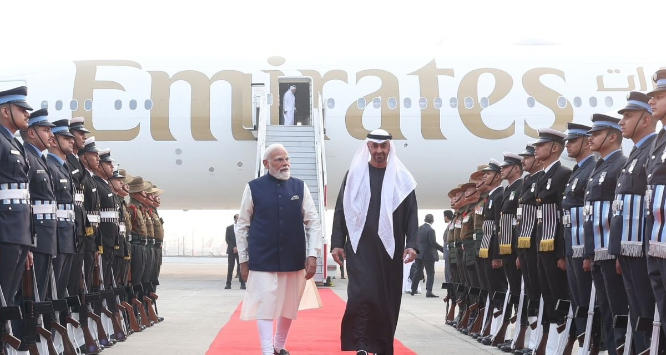
A proposed plan for the United Arab Emirates (UAE) to operate Islamabad International Airport has reportedly been abandoned, delivering a last-minute setback to Pakistan and underscoring shifting geopolitical alignments in South Asia. The development comes shortly after UAE President Sheikh Mohamed bin Zayed Al Nahyan’s three-hour stopover in New Delhi, a visit that drew attention for both its brevity and its strategic depth.
According to a report by Pakistan’s The Express Tribune, the UAE has withdrawn from the airport operations proposal that had been under discussion since August 2025. Sources cited by the newspaper said the plan was dropped after Abu Dhabi failed to identify a suitable local partner to outsource airport operations, despite showing initial interest.
While no official political reason has been cited, the timing of the decision has triggered speculation about broader regional realignments—particularly in the context of evolving India–UAE ties and Pakistan’s deepening defence partnership with Saudi Arabia.
Islamabad Airport proposal quietly shelved
The proposal involved UAE participation in managing Islamabad International Airport, leveraging Abu Dhabi’s experience in operating airports in complex and high-risk environments, including Afghanistan. The withdrawal is being viewed in Pakistan as a loss of confidence, especially as the country continues efforts to privatise and restructure key state-owned assets.
Over the past year, Pakistan has pushed forward with privatisation drives, including the sale of Pakistan International Airlines (PIA), amid concerns about governance issues, political interference, and mounting losses at public sector enterprises. Analysts note that airport operations were seen as a relatively attractive proposition, making the UAE’s exit particularly significant.
Regional politics in the backdrop
Although Pakistani media reports have avoided explicitly linking the decision to geopolitics, observers point to widening strains between the UAE and Saudi Arabia, once among the closest Gulf allies. The two countries are now publicly at odds over regional issues, including support for rival factions in Yemen.
At the same time, Pakistan has moved closer to Saudi Arabia, signing a key defence agreement in September 2025 that reportedly treats an attack on one as aggression against both. Islamabad is also seeking to build a broader security framework with Riyadh and Ankara—often described in regional commentary as an “Islamic NATO”.
In contrast, the UAE has taken a different strategic route.
India–UAE defence ties deepen
During Sheikh Mohamed bin Zayed’s recent visit to New Delhi, India and the UAE signed a Letter of Intent aimed at advancing toward a full-fledged Strategic Defence Partnership. The joint statement issued after the meeting indicated that the Comprehensive Strategic Partnership between the two countries has entered a more ambitious, multi-dimensional phase.
Both sides reviewed cooperation across defence, security, trade, energy, and technology, with officials describing the outcome as a long-term geopolitical and geo-economic roadmap.
In a widely noted gesture following the visit, the UAE also approved the release of 900 Indian prisoners, a move seen as a strong signal of goodwill toward New Delhi.
Pakistan–UAE ties under strain
Historically, the UAE has been one of Pakistan’s most important partners—hosting a large Pakistani workforce and serving as a major source of remittances. The two countries also cooperated in defence, energy, and infrastructure investment.
However, relations have faced friction in recent years over issues ranging from worker safety and visa restrictions to licensing disputes and concerns over Pakistan’s infrastructure and regulatory environment. The decision to step away from the Islamabad Airport project appears to reinforce perceptions of growing caution among Gulf investors toward Pakistan.
A shifting regional balance
While the UAE’s withdrawal from the airport proposal may have been driven by operational or commercial factors, its coincidence with rapidly expanding India–UAE strategic cooperation has amplified its geopolitical significance.
For Pakistan, the episode highlights the challenges of balancing Gulf relationships amid regional rivalries. For India, it underscores Abu Dhabi’s increasing comfort with deeper strategic alignment.
As South Asia and West Asia navigate a period of realignment, even short diplomatic visits—and quiet commercial decisions—are proving capable of reshaping the regional equation.